Get Stronger, Recover Faster, and Break Plateaus with Less Strain
Achieve the remarkable muscle growth and strength gains of high-load training without the punishing stress on your joints. Blood Flow Restriction (BFR) training is the scientifically-proven method to unlock your body's full potential, safely and efficiently.
For decades, the path to strength and muscle growth was dictated by a simple, often punishing, philosophy: "no pain, no gain."
This traditional approach requires lifting heavy weights, which, while effective, creates significant problems. The high mechanical loads can lead to chronic joint stress, elevate the risk of overuse injuries, and create significant barriers for individuals in post-operative rehabilitation, those with conditions like osteoarthritis, or older adults seeking to combat age-related muscle loss. This creates a training paradox: how can you achieve the stimulus needed for growth without the associated physical strain?
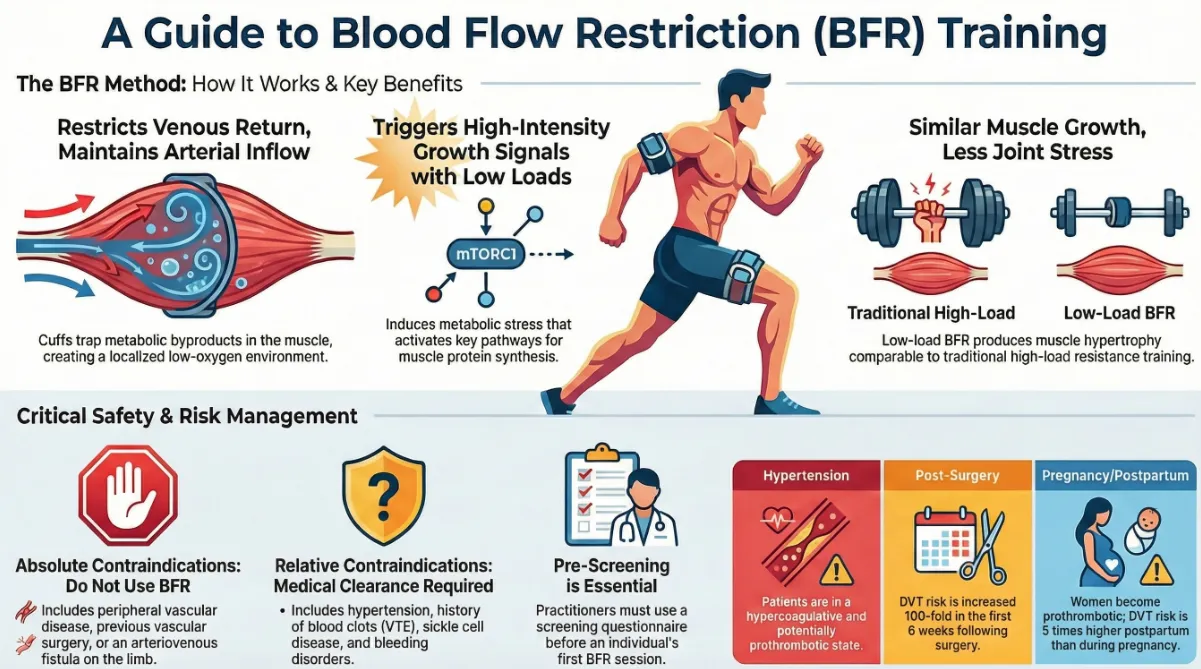
Blood Flow Restriction (BFR) training is the scientific solution to this paradox. BFR is an innovative training modality that involves using specialized, wide pneumatic cuffs placed proximally on the arms or legs. These cuffs are inflated to a precise, individualized pressure that partially restricts venous blood return (the blood leaving the muscle) while maintaining arterial inflow (the blood entering the muscle). This creates a unique physiological environment within the muscle, tricking it into responding as if it were lifting much heavier loads. This technique allows you to achieve significant muscle hypertrophy and strength gains using loads as low as 20-40% of your one-repetition maximum (1RM), a stark contrast to the 70-85% 1RM typically required by traditional methods.
But how can such light weights trigger such a powerful response? The answer lies in a cascade of well-documented physiological mechanisms that work together to create a potent anabolic signal.

Achieve significant muscle hypertrophy and strength gains using loads as low as 20-40% of your 1RM, compared to the 70-85% typically required.
The remarkable effectiveness of Blood Flow Restriction training isn't magic; it is grounded in robust, well-documented physiological science.
By creating a localized, controlled stress environment, BFR initiates a powerful cascade of muscle-building signals that are typically only accessible through high-intensity, heavy-load exercise. Understanding this science is the key to trusting the process and appreciating its power to safely transform your physical potential.
Watch: The complete science behind Blood Flow Restriction training explained by leading experts
Comprehensive guide to BFR training method, benefits, and safety protocols
Detailed explanation of BFR mechanism and physiological benefits
By partially restricting venous outflow, BFR traps metabolic byproducts like lactate and hydrogen ions within the working muscle. This prevents the metabolites from being cleared efficiently, rapidly creating a localized hypoxic (low-oxygen) and acidic environment. This intense metabolic stress is one of the primary triggers for anabolic processes, closely mimicking the internal state your body experiences during exhaustive, high-intensity exercise.
Ordinarily, low-load exercise primarily recruits Type I (slow-twitch) muscle fibers. However, the hypoxic environment created by BFR causes these fatigue-resistant fibers to fatigue very quickly. This forces your central nervous system to recruit the larger, more powerful Type II (fast-twitch) muscle fibers much earlier and at a much lower load. This is profoundly significant because Type II fibers have the greatest potential for increasing both muscle size (hypertrophy) and strength. BFR provides a low-load "shortcut" to activating these high-growth-potential fibers.
The metabolic stress induced by BFR activates key cell growth pathways. Most notably, it stimulates the mTORC1 signaling pathway, a crucial regulator that is essential for increasing muscle protein synthesis—the fundamental process of building new muscle tissue. Concurrently, BFR has been shown to increase the proliferation of myogenic satellite cells, the stem cells responsible for repairing muscle damage and adding new nuclei to muscle fibers, which is necessary for long-term growth and adaptation.
The restriction of venous return causes fluid to accumulate within the muscle cells, a phenomenon known as cellular swelling or "the pump." This fluid accumulation places mechanical tension on the cell wall itself. The cell perceives this swelling as a threat to its structural integrity and responds by initiating a protective, anabolic response to reinforce its structure. This process, called mechanotransduction, acts as an independent muscle-building signal that works in synergy with the metabolic stress to maximize the hypertrophic response.
Together, these powerful mechanisms explain how BFR allows you to build muscle and strength with lighter weights, translating scientifically validated principles into tangible, real-world benefits for a vast range of users.
The strategic importance of BFR lies in its unparalleled versatility. Unlike high-load training, which has a narrow range of application, BFR is a uniquely adaptable tool that offers targeted benefits to diverse populations.
A Game-Changer for Recovery
BFR is a revolutionary tool for accelerating rehabilitation. It allows patients to begin strengthening muscles much earlier after procedures like ACL reconstruction, even when their joints are load-compromised and cannot tolerate heavy weights. By stimulating muscle protein synthesis with minimal mechanical stress, BFR effectively prevents disuse atrophy, a major challenge in recovery. Furthermore, BFR has been shown to produce a proven hypoalgesic (pain-reducing) effect, making therapy sessions more tolerable and productive.
Breaking Performance Plateaus
For trained athletes, High-Load BFR Training (HL-BFRT) offers a new frontier. By combining the mechanical tension of heavy lifting with the metabolic stress of BFR, this method shows potential advantages over traditional heavy lifting for improving strength, power, speed, and endurance. It also serves as an invaluable tool for in-season athletes, allowing them to maintain fitness and muscle mass with significantly less mechanical stress, thereby reducing the risk of overuse injuries during competition periods.
Counteracting Sarcopenia
BFR offers a powerful solution to age-related muscle loss (sarcopenia). It provides a safe, effective, and accessible way for older adults to build and maintain essential muscle mass and strength without the risks associated with heavy weights, such as joint pain or injury. Studies have shown significant benefits even when BFR is applied during low-intensity activities like walking, making it an ideal modality for improving muscular fitness, function, and overall quality of life in aging populations.
While the benefits of BFR are vast, achieving them safely and effectively depends entirely on using the right equipment and adhering to evidence-based protocols.
Blood Flow Restriction is a precise, scientific modality, not a workout hack. The difference between a safe, effective session and a risky one lies in proper knowledge, application, and equipment.
Simply tightening a strap around a limb is an uncontrolled and dangerous practice. As a responsible, evidence-based leader in the BFR space, we believe that your safety is paramount. True efficacy can only be achieved when the following non-negotiable principles are respected.
The cornerstone of safe and effective BFR is the concept of Limb Occlusion Pressure (LOP), also known as Arterial Occlusion Pressure (AOP). This is the minimum pressure required to completely stop arterial blood flow to the limb. Safe BFR protocols never use 100% of this pressure during exercise. Instead, a specific percentage of this individualized pressure (typically 40-80%) is applied. Using an arbitrary, absolute pressure for everyone is unsafe and fails to account for critical differences in limb size, blood pressure, and tissue density.
The physical width of the cuff is a critical safety factor. Scientific evidence clearly shows that wider cuffs are safer because they require significantly less absolute pressure to achieve the desired venous occlusion compared to narrow cuffs. A wider cuff distributes pressure more evenly and effectively, achieving the necessary physiological effect with less external force. This directly reduces cardiovascular strain and the risk of adverse events.
To apply an individualized percentage of LOP, you must be able to measure pressure accurately. Professional-grade pneumatic cuffs are engineered with digital gauges to provide precise, reliable, and reproducible pressure readings. This is impossible with simple elastic straps or bands, which offer no objective measurement. Accurate measurement is essential for ensuring safety, tracking progress, and achieving consistent results session after session.
BFR is not for everyone. A thorough screening process is essential to identify individuals for whom BFR would be unsafe. Critical absolute contraindications include a personal history of Deep Vein Thrombosis (DVT), a personal history of Pulmonary Embolism (PE), clotting disorders, and untreated severe hypertension. Individuals with established cardiovascular conditions should seek medical clearance from their physician before beginning BFR training.
Our products are the embodiment of these safety principles, meticulously designed to deliver the full benefits of BFR without compromise.
Explore our comprehensive safety guide covering risk assessment, screening protocols, and clinical implementation guidelines.
Read the Complete Safety GuideWe present the definitive solution for serious BFR practitioners. Our products are the professional-grade choice engineered for users who prioritize safety, precision, and scientifically-proven results.
This all-in-one system provides everything you need to implement precise, LOP-based BFR training for both the upper and lower body.
The Complete Kit is built on a foundation of safety and efficacy. The wide-cuff design ensures that the target occlusion is achieved at lower, safer absolute pressures, maximizing comfort and minimizing cardiovascular strain. The cuffs are crafted from a durable, non-porous material that is easy to clean and sanitize between users—a critical feature for clinical and professional settings.
The centerpiece of the kit is the wireless digital gauge, which allows you to accurately measure each individual's LOP and apply a precise, evidence-based percentage for consistent, safe, and effective training.
Cuffs + Certification Course
For professionals and dedicated users who want to master the science of BFR, the Pro-Trainer Bundle combines our Complete Kit with a comprehensive online certification course.
This bundle includes the "BFR Cuffs Complete Kit" plus an extensive, multi-module video course taught by leading expert Dr. Nicholas Rolnick PT, MS, CSCS. This comprehensive online course provides an in-depth education on the physiology, application, and safety protocols of BFR.
You will learn how to confidently screen individuals, accurately measure LOP, and design and implement safe and effective BFR programs for yourself or your clients, ensuring you can apply this powerful modality with the highest level of competence.
Our mission is to empower you with not only the best tools but also the best education, ensuring that every BFR session is safe, effective, and grounded in science.
Yes, when performed correctly. Research shows that when BFR is implemented with proper equipment, adherence to individualized pressure guidelines (based on LOP), and appropriate pre-participation screening, it does not increase the risk of adverse events any more than standard exercise. Serious adverse events like rhabdomyolysis or thromboembolic events are very infrequent and are typically associated with improper use, such as using excessively high pressures or unsafe equipment.
No. According to systematic reviews of the scientific literature, there is no evidence to support an increased risk of thromboembolic events (blood clots) with the proper use of BFR. In fact, some evidence suggests BFR may have a protective effect by stimulating the body's natural fibrinolytic system, which helps break down clots.
The correct pressure is always a percentage of your individual Limb Occlusion Pressure (LOP), which must be measured with a reliable device like a digital pressure gauge or Doppler ultrasound. The recommended training pressure is typically between 40-80% of your measured LOP. You should never use an arbitrary pressure or simply "tighten a strap until it feels right," as this is both unsafe and ineffective.
The cuffs should only be placed on the most proximal part of the limbs. This means at the top of the upper arm (close to the shoulder) or the top of the upper thigh (close to the hip). Cuffs should never be placed on the forearms or calves. Nerves and arteries in these lower limb segments are more superficial, and applying pressure there substantially increases the risk of adverse events.
Individuals with certain pre-existing conditions should avoid BFR. The key absolute contraindications are:
Anyone with pre-existing medical conditions, particularly cardiovascular issues, should consult their physician before starting BFR training.
Join thousands of athletes, rehabilitation professionals, and fitness enthusiasts who have discovered the power of scientifically-proven BFR training.
Professional-grade equipment backed by science. Safe, effective, and built to last.